On 11th of February 2026, three previous PhD students from the QuantumFuture group defended their theses in front of an evaluation committee. We would like to extend our congratulations to the new graduated PhDs: Dr. Matías Rubén Bolaños Wagner, Dr. Alberto De Toni, and Dr. Massimo Giacomin.
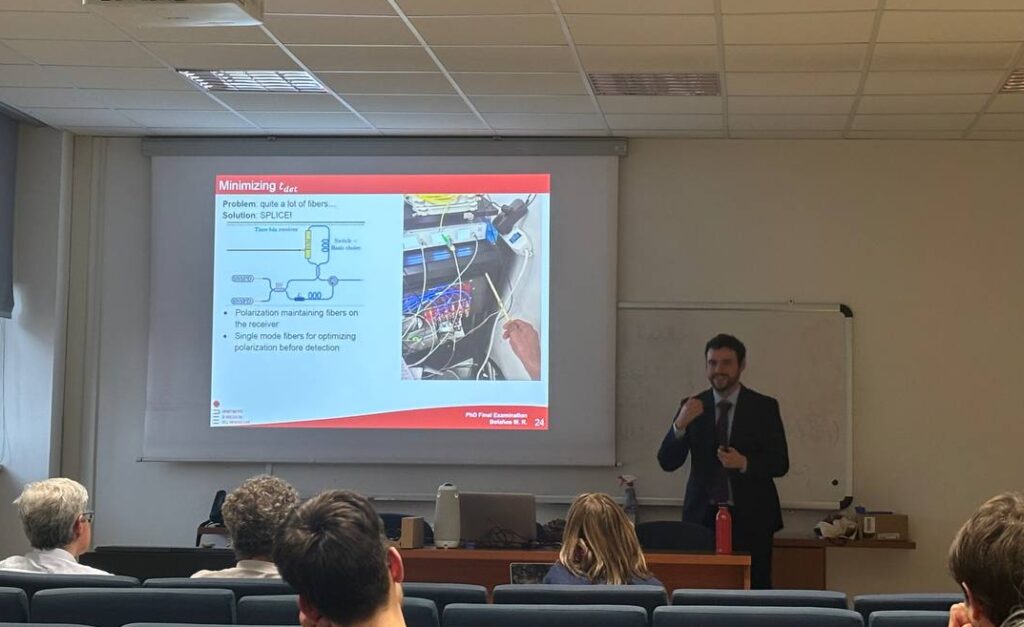
Dr. Matías Rubén Bolaños Wagner presented his thesis, titled “Development of high performance systems for quantum communications”, which presents the design and implementation of high-performance hardware systems for quantum communication, both for discrete-variable (DV) and continuous-variable (CV) systems. His work combines FPGA-based digital logic, optoelectronic control, and quantum optics to enable fast, stable, and reconfigurable experimental platforms. These technologies are applied to the realization of polarization- and time-bin-encoded sources for QKD, achieving gigahertz operation rates for the first and supporting high-dimensional quantum states for the second, with excellent phase stability for both. The same hardware framework is extended to digital signal processing for CV-QKD, demonstrating also the coexistence of DV and CV schemes within the same optical channel. His thesis aims to highlight recent developments in the pursuit of higher performance and scalability of quantum communication systems, paving the way for the realization of practical, large-scale QKD networks.
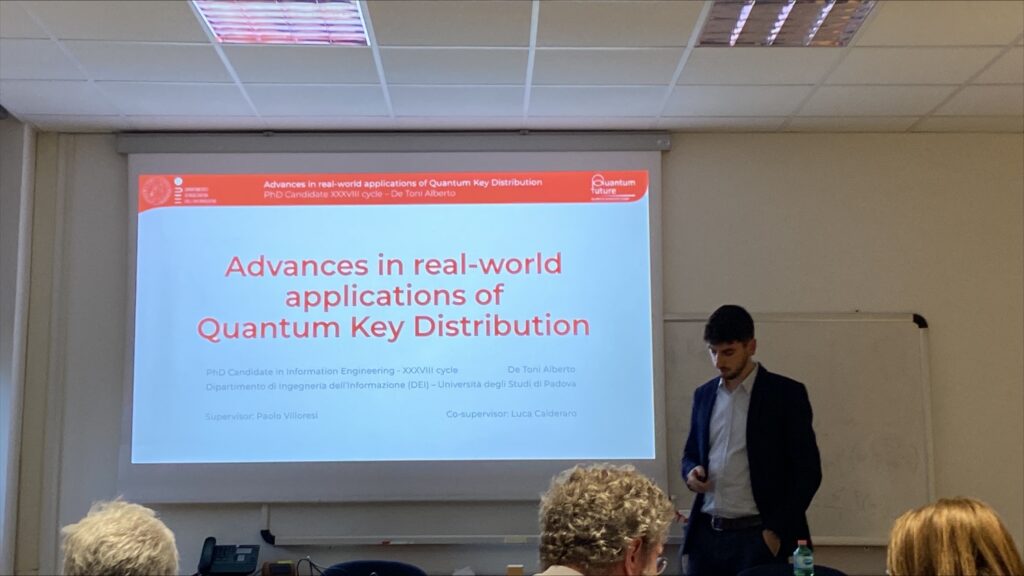
Dr. Alberto De Toni presented his thesis, titled “Advances in real-world applications of Quantum Key Distribution”, which addresses the challenges of speed, stability, and security in transitioning Quantum Key Distribution (QKD) from laboratory environments to real-world applications. His work introduces a complete theoretical model and novel symmetric designs for Sagnac-based optical modulators, overcoming traditional repetition-rate limitations to achieve stable operation speeds exceeding 1.5 GHz. These high-performance encoders facilitate the realization of a robust polarization-based QKD system which, developed for the QUANGO project, demonstrated exceptional secret key rates over both fiber and urban free-space links. The framework is further extended to the deployment of VenQCI, a 4-node metropolitan network integrating quantum layers with commercial telecom infrastructure, alongside a rigorous security analysis of the optical hardware against Trojan-Horse attacks. His thesis aims to bridge the gap between component-level innovation and deployed infrastructure, paving the way for scalable and unconditionally secure global communication networks.
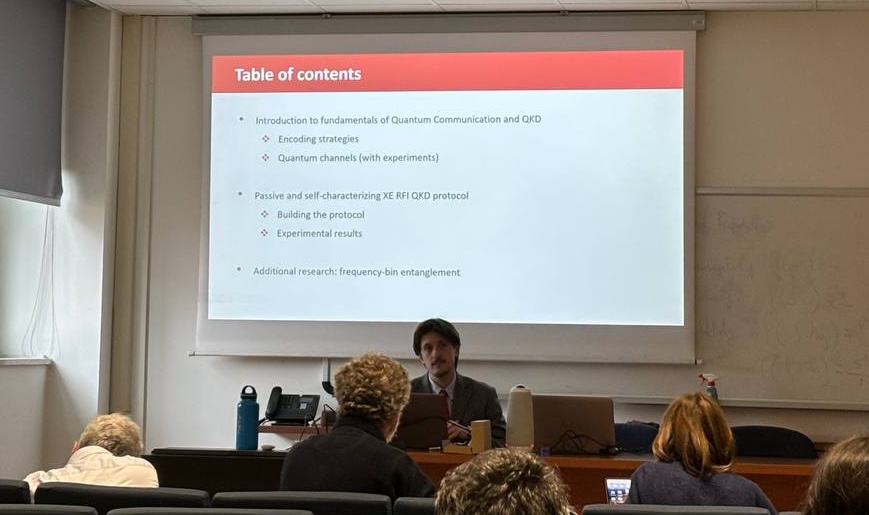
Dr. Massimo Giacomin presented his thesis, titled “Advanced quantum communication system based on reference-frame-independent configuration”, which addresses the urgent need for unconditionally secure encryption in an era where advancing quantum computing power threatens traditional cybersecurity. His work focuses on the evolution of Quantum Key Distribution (QKD) protocols designed to function reliably in harsh conditions by mitigating the strict requirements for alignment between communicating parties. Specifically, the thesis investigates the family of Reference Frame Independent (RFI) protocols, proposing a robust alternative that relaxes the constraints of a shared reference frame which typically demands complex control schemes. This innovative approach utilizes an advanced self-calibration technique at the receiver, capable of characterizing and accounting for physical imperfections to distill cryptographic keys with a high level of security. His thesis aims to enhance the resilience and practicality of quantum communication systems, offering a reliable solution for global networks that guarantees secrecy against even the most powerful future computational threats.