
Lorenzo Coccia1, Matteo Padovan1, Andrea Pompermaier1, Mattia Sabatini1, Marco Avesani1,2, Davide G. Marangon1, Paolo Villoresi1,2 & Giuseppe Vallone1,2
npj Quantum Inf 12, 29
DOI: 10.1038/s41534-025-01175-x
1Università degli Studi di Padova, Dipartimento di Ingegneria dell’Informazione, Padua, Italy
2Padova Quantum Technologies Research Center, Università degli Studi di Padova
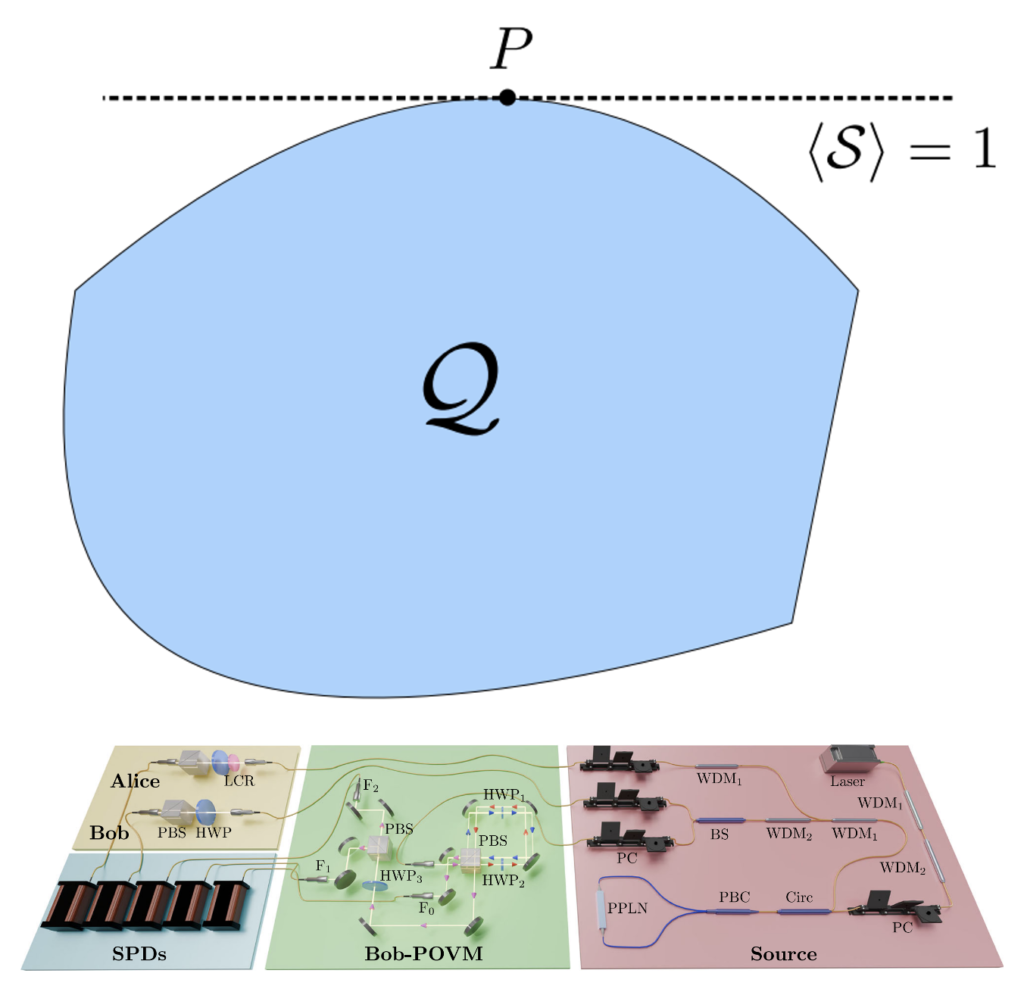
Device-independent (DI) quantum protocols use Bell inequality violations to ensure security or certify quantum properties without assumptions on the devices’ internal workings. In this work, we study the role of rank-one qubit positive operator-valued measures (POVMs) in DI scenarios. This class includes all qubit extremal POVMs, i.e., those measurements that cannot be realized as mixtures of others, as well as part of non-extremal POVMs, recently shown to be useful in sequential quantum protocols. We demonstrate that any rank-one POVM can generate correlations in bipartite scenarios that saturate a Tsirelson inequality when two parties share an arbitrary entangled two-qubit state and perform specific self-tested measurements. For extremal POVMs, such saturation enables explicit computation of guessing probability and worst-case conditional von Neumann entropy. From the Tsirelson inequality, we establish a randomness certification method that facilitates numerical simulations and we validate it through a proof-of-concept experiment with three-outcome POVMs and tilted entangled states.