cemre

cemre

Quantum bounds and device-independent security with rank-one qubit measurements
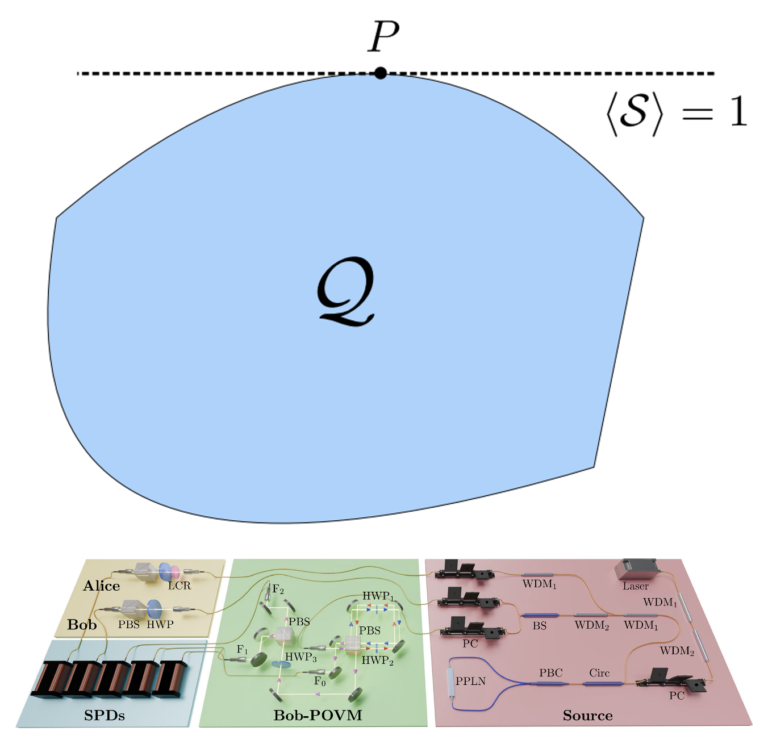
Device-independent (DI) quantum protocols use Bell inequality violations to ensure security or certify quantum properties without assumptions on the devices’ internal workings. In this work, we study the role of rank-one qubit positive operator-valued measures (POVMs) in DI scenarios. This class includes all qubit extremal POVMs, i.e., those measurements that cannot be realized as mixtures of others, as well as part of non-extremal POVMs, recently shown to be useful in sequential quantum protocols. We demonstrate that any rank-one POVM can generate correlations in bipartite scenarios that saturate a Tsirelson inequality when two parties share an arbitrary entangled two-qubit state and perform specific self-tested measurements. For extremal POVMs, such saturation enables explicit computation of guessing probability and worst-case conditional von Neumann entropy. From the Tsirelson inequality, we establish a randomness certification method that facilitates numerical simulations and we validate it through a proof-of-concept experiment with three-outcome POVMs and tilted entangled states.

PhD defense of 11/02/2026

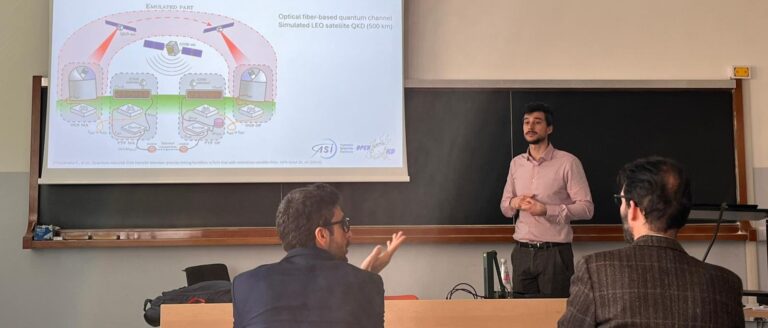
On 11th of February 2026, three previous PhD students from the QuantumFuture group defended their theses in front of an evaluation committee. We would like to extend our congratulations to the new graduated PhDs: Dr. Matías Rubén Bolaños Wagner, Dr.…

PhD defense of 09/01/2026

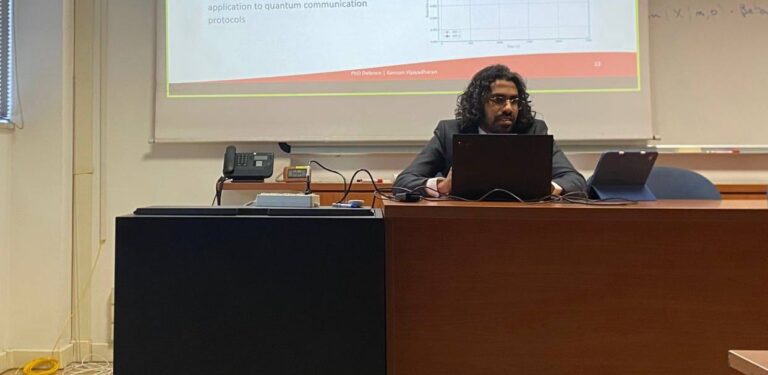
On the 9th of January 2026, Kannan Vijayadharan from the QuantumFuture group defended his thesis in front of an evaluation committee. We would like to extend our congratulations to the newly graduated PhD, Dr. Kannan Vijayadharan. Dr. Kannan Vijayadharan presented…

PhD defenses of 31/03/2025

On 31st of March 2025, three previous PhD students from the QuantumFuture group defended their theses in front of an evaluation committee. We would like to extend our congratulations to the new graduated PhDs: Dr. Ilektra Karakosta-Amarantidou, Dr. Elisa Bazzani,…

High-speed source-device-independent quantum random number generator on a chip

A wide range of applications require, by hypothesis, to have access to a high-speed, private, and genuine random source. Quantum random number generators (QRNGs) are currently the sole technology capable of producing true randomness. However, the bulkiness of current implementations significantly limits their adoption. In this work, we present a high-performance source-device-independent QRNG leveraging a custom-made integrated photonic chip. The proposed scheme exploits the properties of a heterodyne receiver to enhance security and integration to promote spatial footprint reduction while simplifying its implementation. These characteristics could represent a significant advancement toward the development of generators better suited to meet the demands of portable and space applications. The system can deliver secure random numbers at a rate greater than 20 Gbps with a reduced spatial and power footprint.

PhD defense of 30/01/2025

On the 30th of January 2025, Matteo Padovan from the QuantumFuture group defended his thesis in front of an evaluation committee. We would like to extend our congratulations to the newly graduated PhD, Dr. Matteo Padovan. Dr. Matteo Padovan presented…