Matias El ruben

Matias El ruben

Extending Wheeler’s delayed-choice experiment to Space
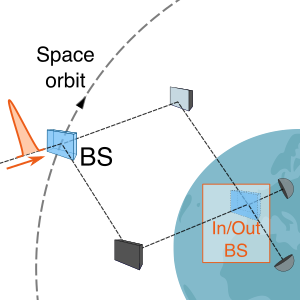
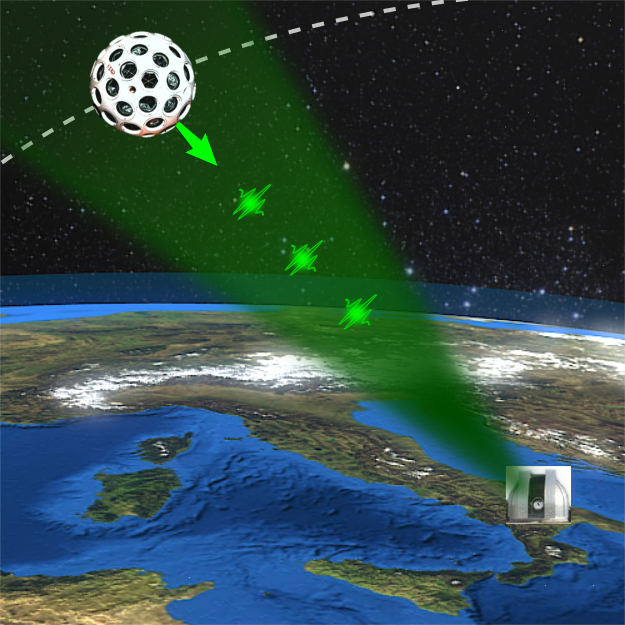
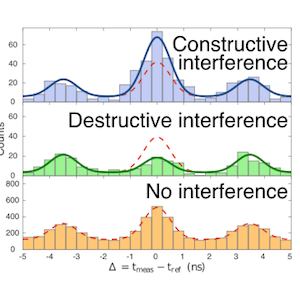
One of the most surprising and counterintuitive aspects of Quantum Mechanics is the wave-particle duality, more precisely the impossibility of describing the fundamental elements of nature exclusively as waves or as particles. In fact, Quantum Mechanics requires all elementary particles to be treated contemporaneously as waves and as particles, but forbids both characters to be observed simultaneously. In 1978 John Archibald Wheeler conceived a Gedankenexperiment, or thought-experiment, that takes the implications of Quantum Mechanics to the extreme, demonstrating that a classical description would lead to a seeming inversion of the normal order of time and thus a violation of the causality principle. Building upon the results of our research group in Satellite Quantum Communications and as part of the collaboration between the Matera Laser Ranging Observatory of the Italian Space Agency, we published a manuscript (Vedovato et al, Sci. Adv. 2017;3:e1701180) where we perform the first satellite version of Wheeler’s Gedankenexperiment. By exploiting the polarization degree of freedom and the temporal modes of photons reflected by satellites in a low Earth orbit, we demonstrated the necessity of the quantum treatment in the hostile space environment. Furthermore we have paved the way for further tests and applications of quantum theory in Space.
Source-Device-Independent Ultrafast Quantum Random Number Generation

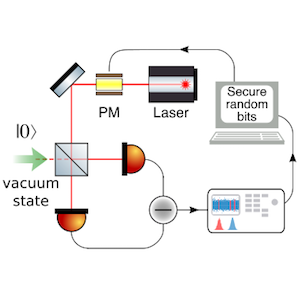
Measurements of the electromagnetic vacuum fluctuations allowed the generation of random numbers at a gigabits per second rate and with an enhanced security level with respect to the state-of-the-art quantum random number generators (QRNG). Random numbers, employed in any cryptographic algorithm, are of paramount importance for security applications. It is well known that physical systems and processes governed by quantum mechanics feature intrinsic non-deterministic behaviours that can be used to generate unpredictable random numbers. With respect to the QRNG state-of-the-art, in this work we designed and realized a novel protocol able to merge an enhanced level of security with an ultrafast rate of generation. The protocol is resilient against an extreme class of “guessing attacks”. Such attacks indeed contemplate the worst case scenario, in which an adversary is able to control the generator quantum source itself, the so-called semi-device-independent (SDI) framework. In our protocol, the Heisenberg Uncertainty Principle is used not only to generate the random numbers, as most of the previous QRNGs do, but also to secure them by erasing any guessing advantage an extremely resourceful adversary might achieve. By applying the SDI approach to the measurement of the vacuum fluctuations of the electromagnetic field, we give an experimental demonstration of secure random number generation at a rate of gigabits per second. Such a result is obtained by employing commercially available hardware and could be easily improved to reach rates of tens of gigabits per second. This novel scheme is able to provide unpredictability at the highest levels, while keeping low the setup complexity and achieving a generation rate able to satisfy the even growing demand of ultrafast streams of secure random numbers.

Space Quantum Communications on the news

In June 2014 we posted on the ArXiv the results on the first realization of quantum communication from satellite [arXiv:1406.4051]. New Scientist reacted rapidly with First quantum transmission sent through space as well as the MIT Technology Review, with the…

Interference at the single photon level along satellite-ground channels

Interference of quantum objects has been a key ingredient in the description of microscopic world since the early development of Quantum Theory. Testing the predictions of Quantum Mechanics in Space, over distances larger and larger, allows to extend its validity limits on a scale at which it was originally not meant for. Furthermore, exploiting quantum technologies in Space could have great implications for secure communications at global scale and for testing Einstein’s gravitation one more time. Here, we demonstrated interference at the single-photon level along optical links between the Matera Laser Ranging Observatory (Italian Space Agency) and different satellites thousand kilometers away. Two short pulses of light delayed by few nanoseconds are sent to the satellite which bounces them back to Earth where they are collected at the single-photon level because of the long journey. At the reflection the satellite introduces a phase-shift between the two pulses, due to its relative velocity respect to the ground station. When the photons are temporally recombined at the receiver, they interfere accordingly to the modulation imposed by the satellite motion.

A fast source-independent QRNG

A novel scheme for ultrafast Quantum Random Number Generators exploiting from the quadratures of an electromagnetic field without any assumption on the input state. The method allows to eliminate the numbers that can be predict due the presence of classical…

Experimental single-photon exchange along a space link of 7000 km

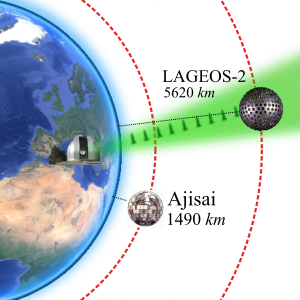
The unprecedented single photon exchange with a MEO satellite range was annoucend in a manuscript posted in Sep. 2015 in the ArXiv with number [arXiv:1509.05692] by Daniele Dequal, Giuseppe Vallone, Davide Bacco, Simone Gaiarin, Vincenza Luceri, Giuseppe Bianco, and Paolo Villoresi. The satellite distance was more than 7000 km to the ground station at the Matera Laser Ranging Observatory. The single photon transmitter was realized by exploiting the corner cube retro-reflectors mounted on the LAGEOS-2 satellite. Long duration of data collection is possible with such altitude, up to 43 minutes in a single passage.

Free-space quantum key distribution by rotation-invariant twisted photons

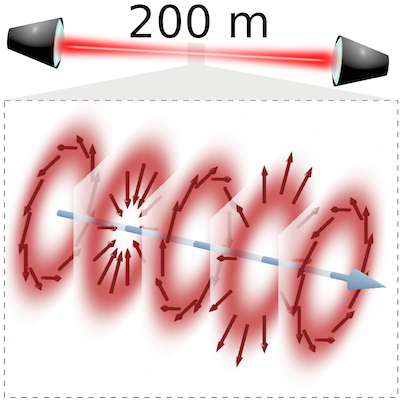
“Twisted photons” are photons carrying a well-defined nonzero value of orbital angular momentum (OAM). The associated optical wave exhibits a helical shape of the wavefront (hence the name) and an optical vortex at the beam axis. The OAM of light is attracting a growing interest for its potential in photonic applications ranging from particle manipulation, microscopy, and nanotechnologies to fundamental tests of quantum mechanics, classical data multiplexing, and quantum communication. Hitherto, however, all results obtained with optical OAM were limited to laboratory scale. Here, we report the experimental demonstration of a link for free-space quantum communication with OAM operating over a distance of 210 m. Our method exploits OAM in combination with optical polarization to encode the information in rotation-invariant photonic states, so as to guarantee full independence of the communication from the local reference frames of the transmitting and receiving units. In particular, we implement quantum key distribution, a protocol exploiting the features of quantum mechanics to guarantee unconditional security in cryptographic communication, demonstrating error-rate performances that are fully compatible with real-world application requirements. Our results extend previous achievements of OAM-based quantum communication by over 2 orders of magnitude in the link scale, providing an important step forward in achieving the vision of a worldwide quantum network.

Experimental Satellite Quantum Communications

Quantum communication (QC), namely, the faithful transmission of generic quantum states, is a key ingredient of quantum information science. Here we demonstrate QC with polarization encoding from space to ground by exploiting satellite corner cube retroreflectors as quantum transmitters in orbit and the Matera Laser Ranging Observatory of the Italian Space Agency in Matera, Italy, as a quantum receiver. The quantum bit error ratio (QBER) has been kept steadily low to a level suitable for several quantum information protocols, as the violation of Bell inequalities or quantum key distribution (QKD). Indeed, by taking data from different satellites, we demonstrate an average value of QBER=4.6% for a total link duration of 85 s. The mean photon number per pulse μsat leaving the satellites was estimated to be of the order of one. In addition, we propose a fully operational satellite QKD system by exploiting our communication scheme with orbiting retroreflectors equipped with a modulator, a very compact payload. Our scheme paves the way toward the implementation of a QC worldwide network leveraging existing receivers.

Random bits, true and unbiased, from atmospheric turbulence

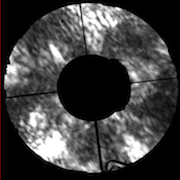
Random numbers represent a fundamental ingredient for secure communications and numerical simulation as well as to games and in general to Information Science. Physical processes with intrinsic unpredictability may be exploited to generate genuine random numbers. The optical propagation in strong atmospheric turbulence is here taken to this purpose, by observing a laser beam after a 143 km free-space path. In addition, we developed an algorithm to extract the randomness of the beam images at the receiver without post-processing. The numbers passed very selective randomness tests for qualification as genuine random numbers. The extracting algorithm can be easily generalized to random images generated by different physical processes.

Experimental Quantum Key Distribution with finite-key security analysis for noisy channels

Exchanging unconditionally secure cryptographic keys by means of a free-space quantum channel is possible even under realistic conditions, that is, in the presence of environmental noise and with the transmission of a limited number of photons, as for Satellite Quantum Communications.
In their work, just published on Nature Communications, Davide Bacco, Matteo Canale, Nicola Laurenti, Giuseppe Vallone and Paolo Villoresi, all with the Department of Information Engineering at the University of Padova, have experimentally proved the feasibility of Quantum Key Distribution (QKD) in such conditions and by considering different attack models.
This result opens perspectives for scenarios where the transmission window is limited by physical constraints, as for Satellite Communications, where the passage of one terminal over the other is restricted to a few minutes.