Category Uncategorized

Postselection-loophole-free Bell test under strict spacetime constraints

Entanglement gives rise to correlations between distant quantum systems that cannot be explained by local realistic theories. Bell inequality violations provide a direct way to reveal these correlations and certify nonlocality, especially when the relevant experimental loopholes are closed. Time-bin encoding, in which quantum information is encoded into well-defined temporal modes, is a commonly used platform for distributing photonic entanglement in optical fibers. Yet loophole-free Bell tests with time-bin entanglement have received comparatively little attention, owing in part to the postselection loophole introduced by conventional interferometric measurements. Here, we demonstrate a fiber‑based platform for Bell tests with time-bin entanglement that simultaneously closes the locality, freedom-of-choice, and postselection loopholes. We observe a CHSH violation of $S=2.583 \pm 0.002$, exceeding the local‑realistic bound by over 265 standard deviations. Notably, this rigorous certification of nonlocality is achieved at a separation distance of $49.0\pm0.7$~m, substantially shorter than previous photonic Bell tests addressing comparable space-time constraints. Beyond its foundational significance, our results demonstrate time‑bin entanglement as a viable route towards practical device‑independent quantum communication and a future quantum internet.
Multiplexing of CV and DV QKD Systems over Fibered and Free-Space Channels and Squeezed- and coherent-state quantum key distribution over a deployed hybrid fibre-free-space channel

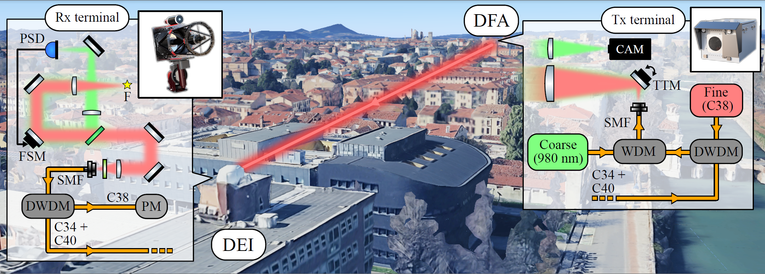
Future quantum communication infrastructures will need to serve heterogeneous users on shared physical channels: short-range, high-throughput links favor Continuous-Variable Quantum Key Distribution (CV-QKD), while long-reach, high-loss links remain the domain of Discrete-Variable QKD (DV-QKD). Wavelength-division multiplexing (WDM) of the two protocols on a common channel would address both regimes simultaneously, but their markedly different noise sensitivities make coexistence non-trivial and, to date, experimentally untested. Here we report the first simultaneous operation of two independent CV- and DV-QKD systems on a common optical channel, using standard C-band DWDM filters at 1550.12 nm (CV) and 1545.32 nm (DV). We demonstrate joint operation on both optical fiber and a 620 m urban daylight free-space link. On fiber, the two systems exhibit the expected complementarity, crossing over at 7.56 dB of channel loss where both deliver ∼1.43 Mbit/s; in daylight free-space, both sustain Mbit/s key rates under time-varying atmospheric attenuation. Across all configurations we observe no measurable multiplexing-induced penalty in QBER or excess noise. These results establish hybrid CV-DV WDM as a practical building block for heterogeneous quantum communication networks, where metropolitan high-throughput users and long-reach backbone links can be served on a single physical infrastructure.